THE GIVING TREE
© 1986 by Shel Silverstein

Synopsis
A classic book for all ages—for mothers and fathers! A moving parable about the gift of giving and the capacity to love, told throughout the life of a boy who grows to manhood and a tree that selflessly gives him her bounty through the years.

Friday, February 11, 2011

AT&T the Worst US Carrier: Consumer Reports Survey


Courtesy and copyright of http://hothardware.com/ HotHardware and Michael Santo

AT&T the Worst US Carrier: Consumer Reports Survey

So many cell phone users complain about AT&T service that you might assume the beleaguered iPhone carrier is the worst in the nation. You'd be right, at least according to Consumer Reports.

More than half of the AT&T respondents to Consumer Reports' survey were iPhone users. Because of the issues that iPhone users have had with AT&T's overstressed network, that was both good and bad news for the carrier.

In fact, AT&T was the only carrier whose scores for overall satisfaction dropped significantly since last year's CR survey. In a couple of surprises, US Cellular, a regional carrier that services 26 states, took the top spot, and Sprint pulled nearly even with Verizon. Verizon has long held the top spot among U.S. carriers for overall satisfaction. T-Mobile was only slightly behind Sprint and Verizon in overall satisfaction.

AT&T remains the fastest 3G carrier, when you can connect. And, of course, there's the problem of all those dropped calls.

Paul Reynolds, Electronics Editor for Consumer Reports said something that you know Verizon and Apple have been discussing:
"Our survey suggests that an iPhone from Verizon Wireless, which is rumored, could indeed be good news for iPhone fans."


Meanwhile, AT&T has issued the following statement:
We take this seriously and we continually look for new ways to improve the customer experience. The fact is wireless customers have choices and a record number of them chose AT&T in the third quarter, significantly more than our competitors. Hard data from independent drive tests confirms AT&T has the nation's fastest mobile broadband network with our nearest competitor 20 percent slower on average nationwide and our largest competitor 60 percent slower on average nationwide. And, our dropped call rate is within 1/10 of a percent—the equivalent of just one call in a thousand—of the industry leader.
The January CR issue also details the top smartphones. You can see, from the following, just how far Android has come:
  • Verizon: Motorola's Droid X and Samsung's Fascinate tie for first with 75 points
  • AT&T: Apple's iPhone 4 and Samsung's Captivate tie for first with 76 points
  • Sprint: Samsung's Epic 4G for Sprint, with 76 points
  • T-Mobile: Samsung's Vibrant for T-Mobile, 76 points
The Samsung phones are all Galaxy S variants, so basically Samsung has the top smartphone at all of the Big 4 carriers. Impressive, particularly with the Samsung Nexus S announcement.

The full press release follows:
CONSUMER REPORTS: AT&T NAMED WORST CELL-PHONE SERVICE PROVIDER
U.S. Cellular Surpasses Former Top Provider Verizon Wireless;
January Report Also Features Tips for Avoiding Bill Shock


YONKERS, NY ? AT&T is now the worst-rated cell-phone service carrier according to a new survey of Consumer Reports readers. U.S. Cellular, a regional carrier that provides service in 26 states, beat out the long-standing top provider Verizon Wireless with outstanding marks for value, voice service and customer support. The full article also features carrier Ratings in 23 metropolitan markets and is in the January 2011 issue of Consumer Reports and at www.ConsumerReports.org.

In this year's version of an annual Consumer Reports survey on cell-phone carriers, more than 58,000 ConsumerReports.org subscribers weighed in about their service and customer support experiences with contract and no-contract providers.

AT&T was the only carrier whose scores for overall satisfaction dropped significantly since last year. Verizon Wireless remains among the better performers, but Sprint has pulled even with the carrier in overall satisfaction. The carrier actually even scored better than Verizon in some aspects of customer service, a remarkable turnaround from past years when that was a weak point for the company. T-Mobile was only slightly behind those two carriers in overall satisfaction.

More than half of the AT&T customers surveyed owned an iPhone, the Apple smart-phone that is currently available exclusively from the carrier. Consumer Reports data, reflecting all versions of the phone, found that iPhone owners were much less satisfied with their carrier and rated data service (Web and e-mail) lower than owners of smart phones on other carriers that, like the iPhone, have a host of apps to encourage heavy data use.

"Our survey suggests that an iPhone from Verizon Wireless, which is rumored, could indeed be good news for iPhone fans," said Paul Reynolds, Electronics Editor for Consumer Reports.

How to Avoid Bill Shock & Cut Cell-Phone Costs

One in five survey respondents reported receiving an unexpectedly high cell-phone bill in the previous year, often for exceeding their plan's voice, text or data limits – an experience called "bill shock." Half of those respondents were hit for at least $50, and one in five for more than $100. Here's some ways consumers can avoid "bill shock" and cut cell-phone costs.
  • Monitor use and act as needed. Consumers should check their use midway through their billing cycle via device settings or online. Pageonce.com sells smart-phone apps that monitor usage and sends users texts or e-mail warnings about overages.
  • Don't overbuy minutes. Consumers should review the voice minutes they have not used in the past six months and consider switching to a plan with fewer billable daytime/anytime minutes, provided it offers the same free-talk time benefits.
  • Avoid termination fees. Sixteen percent of respondents with a contract wanted to switch carriers but didn't want to get hit with early-termination fees that can run as high as $350 per phone early in the contract term. Penalties gradually decline as consumers get further into the contract period. Consider transferring the contract to someone else for a $20 to $25 fee through Celltradeusa.com or Cellswapper.com. To avoid being stuck with a disappointing carrier, test the phone and service during the 15 – to 30-day trial period, consumers who quit a new contract can port their number to another carrier without penalty.
  • Weigh monthly costs. The purchase price of the phone, especially a smart phone, can be a surprisingly small contributor to the total cost of owning it over, say, a two-year period. That's especially true for T-Mobile smart phones, which can be bought with or without a contract, at differing prices and fees.
No-Contract Service

More than 90 percent of Consumer Reports survey respondents' phones were serviced under a contract. Those with no-contract cell-phone service said they made far fewer calls and rarely used data, and perhaps due to their simpler needs were more satisfied overall. Among no-contract service providers, Consumer Cellular scored highest for satisfaction followed by TracFone. AT&T GoPhone was the worst provider in this category receiving relatively low marks for value and voice service.

No-contract service is generally most suitable for light use, but options are expanding beyond bare-bones basics. There are now more conventional phones that provide data service without a contract, a change from the past. And carriers that specialize in no-contract service, including Virgin Mobile and Boost Mobile are offering more smart phones. Verizon and T-Mobile now offer most of their phones, smart and regular with or without a contract, but customers will pay more for the device itself.

Courtesy and copyright of http://hothardware.com/ HotHardware and Michael Santo

Thursday, February 10, 2011

AT&T Customers Continuing to Experience Excessive Dropped Calls posted by Eric Slivka


Courtesy and copyright of MacRumors and Eric Silva.


A new survey from ChangeWave Research reveals that the firm's business-focused survey base is seeing the highest percentage of dropped calls (4.5%) on AT&T, easily exceeding performance leader Verizon (1.5%), as well as Sprint (2.4%) and T-Mobile (2.8%).

Not only is AT&T trailing the other major U.S. carriers, but the poor performance is part of a trend of increasing drop calls against the background of improving performance from rival Verizon, as well as major investments made by AT&T to address performance in some of its most troubled markets.

The survey notes that the percentage of dropped calls for each carrier closely mirrors customer satisfaction, with 49% of survey respondents on Verizon indicating that they are "very satisfied" with their carrier, while only 23% of AT&T customers in the survey pool indicated the same.

ChangeWave's study focused on voice services, where AT&T apparently continues to struggle. A study released earlier this year indicated that AT&T's data service has improved markedly in most markets, pushing 
the carrier to the top of the heap by many metrics.

Courtesy and copyright of MacRumors and Eric Silva.

Wednesday, February 9, 2011

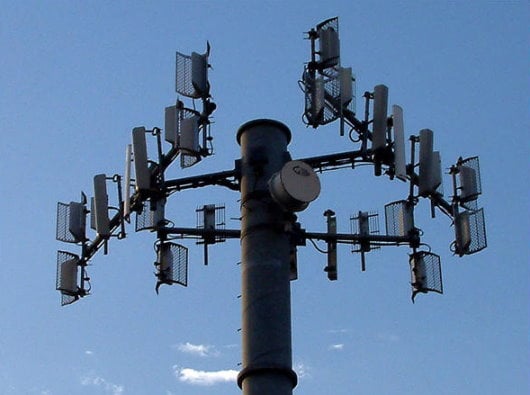
AT&T 3G MicroCell, Cisco Femtocell Tower, Product DPH151-AT


AT&T 3G MicroCell logoI am in the process of cleaning up and optimizing my SOHO internet connectivity.   One item in particular with that I have had bandwidth allocation problems is the AT&T Microcell.  I have been working on it, tweaking and testing for a couple weeks now.  There was most certainly a problem and it wasn’t even worth having.                          

It’s ironic that if you have bad AT&T wireless service at home or at the office, they use it as an excuse for you to purchase a ‘Microcell’ network device from them.  In an area with spotty or no coverage (such as my home), it is basically using a broadband internet connection (in my case a Cox Cable Modem) to replace communication directly with one of their towers.  In includes a GPS so it knows its location (I think mostly for E-911 purposes) but I guess also to prevent it from being used overseas or areas that would be prohibited. According to AT&T's published coverage maps, I should have 5 bar service 3G service at their highest quality rating.  You can check out your area here:AT&T Detailed Coverage Map.

With 1-2 bars of service in my home office, I could not reliably use AT&T service for business or personal calls.  I was having difficulty hearing the caller and the caller was having difficulty understanding me, so I contacted AT&T to report the difficulties that I was having and potential remedies (other than switching carriers).   They told me that I could have full 5 bar coverage throughout my home with a private, small device that connects to your internet and basically converts the call from cell tower, to the “grid” to a VOIP call using the cable modem broadband connection to bypass the tower.

It sounded a little like extortion to me because I believe that if I purchased AT&T wireless service and they were unable to deliver a reliable signal to a densely populated area in a major metropolitan area, that they should be taking action to correct the problem to ensure that I stay a loyal AT&T wireless customer.  Instead, AT&T suggests purchasing their Cisco developed and manufactured booster private labeled as the AT&T Microcell.  Literally, creating a cell tower in my house.

Fortunately, you need to specify which users have permission to use the microcell so at least I don’t have the neighborhood piggybacking on my “cell tower” and my internet connectivity.

Almost every device that I have added to my network suggests that for peak performance that it is plugged directly into the cable modem and then the “Ethernet out” port be used to plug into your primary router.  That means that traffic must pass through an extra device before leaving for the big ‘ol internet.  The “performance” suggestion was to connect the AT&T Microcell to the cable modem directly and then to plug the router into the Ethernet port labeled “Ethernet” next to the port labeled “Internet”.  I don’t like this idea or approach whatsoever because the router should be the workhorse of your network and you lose substantial control when it is connected to another device rather than directly to the internet cable modem.

For example, my router has the capability for QoS, which allows me to specify which traffic gets prioritized/de-prioritized.  For example, streaming a DVD quality video takes priority over sending e-mail or a back-up or sync between computers.  In a more “mission critical” situation, this allows you to prioritize any VOIP traffic to have, take and use as much network capability as it needs and then the router goes down the list allocating any “extra” bandwidth.

If that was not successful, I decided that I could probably use the router function to create a DMZ (de-militarized zone) that basically removes the device from behind the protection of the firewall, packet scans and other possibly slowing (and therefore degrading) the quality of a phone call or video chat over the internet.

For many reasons, including the referenced capabilities above, it would be common Best Practice to put anything and everything BEHIND your router, which is likely, depending on model, acting as a basic firewall and is able to see the “bigger picture” of all the incoming and outgoing traffic and to direct (route) traffic.  If actually defeats the purpose of many of the advanced features of the current generation of home and business routers to stick another device between it (your router) and the internet.  (The only exclusion would be in a much more complex environment where there are actually separate routers and firewalls.  In that scenario the internet [from whatever method] would go through the firewall for a safety check and then once cleared would be passed off to your router.)

Dell XPS M1530Nonetheless, the bottom line is that the only possible way to get the damn thing to work properly and well enough to make normal mobile telephone calls, I was forced to put it in “Priority Mode” as the instructions and AT&T Microcell likes to call it.  Despite my best efforts to use “Best Practices” and control the immense demands of a household of 5 people on my home network, I’ve surrendered to AT&T so we can use our mobile phones while at home.

I will let you know if this is as least a permanent fix for this problem.  I’m optimistic but trepidacious at the same time.

FYI, here is a short list of what is current “on” the network:

Blackberry Torch
  • Dell XPS Laptop
  • Dell Inspiron Laptop
  • Dell Tower Desktop
  • Blackberry Torch (AT&T)
  • Apple iPhone 4 (AT&T)
  • Blackberry Curve (AT&T)
  • Wii Game Console
  • DirecTV Standard Resolution DVR
  • DirecTV HD DVR
  • DirecTV HD DVR
  • Netgear ReadyNAS (1TB Storage)
  • HP Color Laserjet CP1510
  • Brother All-In-One MFC-495CW
  • Linksys / Cisco VOIP Adapter SPA2102
  • Cisco DPH151-AT / AT&T 3G Microcell
  • Router:  DIR-825 XTREME N DUAL BAND GIGABIT ROUTER
  • Motorola  SBV-5222 Cable Modem with integrated 2 line VOIP w/ integrated battery backup


Tuesday, February 1, 2011

Bye Bye iPhone 4 - Good Riddance


The Evolution of the Blackberry, Courtesy of Gizmodo.
  I have been using a Blackberry device since LONG before Blackberry's
had telephones integrated in them. Believe it or not, it was a big
enough step forward to be able to read your e-mail on the go and to
look up anyone's phone number of street address.

Blackberry Model 850

In one hand you would have your green screen Blackberry and your cell phone in the other copying the phone number. Gosh darn it was that advance in technology change the face and pace of work, connectivity and decisions.
Actually the first Blackberry's with integrated phones were widely rejected because there was no speaker or handset - you were required
to use a specially designed, state of the art headset.
The headset sucked, you couldn't use your phone at all if you lost offorgot it and of you did, the battery lasted 15 minutes with luck.
By that time phones had advanced the fancy expensive models had speaker phone and a choice of 5 different ringtones. Imagine that!
Fortunately for Research in Motion they got things figured out just as
the promise of the hold grail of the smart phone emerged.

First Generation iPhone
 As a dedicated Blackberry user I will admit that once the Apple iPhone was launched I just had to have one. That lasted a couple weeks. I quickly learned that the iPhone was great for  ntertainment and "apps" that were mostly games.

If the iPhone was the ultimate entertainment, the Blackberry was still the workhorse of enhanced business productivity worldwide. The Apple iPhone couldn't even copy and paste and 4 generations later it's still clumsy.

iPhone 4 "FaceTime"
My girlfriend at the time had long been addicted to her iPhone (not
for work BTW) and with the release of the iPhone 4 she sacrificed
grocery money from her monthly budget to be one of the first to have
it. I was particularly interested in it's advanced productivity functions, it's "smarter" keyboard and it's ability to videochat (called "FaceTime"). Ithought that would be perfect to connect with business associates and co-workers during the day and, well, other things with my girlfriend at night if we weren't together. Not only did it turn out to be a proprietary system, it requires that you were connected to WI-FI.Experiment failed. The iPhone 4 suck just as badly as the earlier versions.

President Obama on the campaign trail
reacting to something receieved on his Blackberry.
There is a reason The President of the United States of America carries a Blackberry and not an iPhone. Therefore, I found it apropos to use my iPhone 4, as it's final task,to post this blog. I am switching back to a Blackberry.

 I am going to try out the Blackberry Torch with full touchscreen display and slide out keyboard.I am looking forward to returning "home" to the Blackberry world.
Those of you that ate tempted, step back from that ledge my friend.

The iPhone is returning to the heap of bygone phones that my kids play with.I haven't shed a tear, had a second thought other than excitement at the killer deal from Apple. The phone cost .01, free overnight
The Blackberry Torch
shipping and waived activation. How could I say no.
See you next in Blackberry land....

Although after authoring this post, I manually proofread it and looked for typos, I am sure that there are some I missed.  I unfortunately have to blame that with my lack of proficiency of typing on a screen instead of with keys like the Blackberry.  So please, excuse any errors, typos or formating problems.

Tuesday, January 18, 2011

Lunch, Fever and Blood Pressure

Today I was riding in the car as a passenger and suddenly felt extremely ill.  I could tell I was suddenly spiking a fever and that I was starting to shake.  We were on the way to a work related lunch and I had to suck it up and ask to be dropped off at home to get some Tylenol in me and pronto.


One of the things that I haven't yet covered for you is my history of illness.  Going back nearly 20 years, I havealways had some sort of chronic malady going on.  There is an absolute laundry list, but to give you an idea, here are some of the things that I've dealt with:

  • Crohn's Disease / Ulcerative Colitis Crohn's disease, also known as regional enteritis, is an inflammatory disease of the intestines that may affect any part of the gastrointestinal tract from mouth to anus, causing a wide variety of symptoms. It primarily causes abdominal paindiarrhea (which may be bloody if inflammation is at its worst), vomiting, or weight loss,[1][2][3] but may also cause complications outside of the gastrointestinal tract such as skin rashesarthritisinflammation of the eye, tiredness, and lack of concentration
  • Chronic Pancreatitis Chronic pancreatitis is a long-standing inflammation of the pancreas that alters its normal structure and functions. It can present as episodes of acute inflammation in a previously injured pancreas, or as chronic damage with persistent pain or malabsorption.
  • Reynaud's Phenomenon  In medicineRaynaud's phenomenon (pronounced /reɪˈnoʊz/US dict: rā·nōz′) is a vasospastic disorder causing discoloration of the fingers, toes, and occasionally other areas. This condition can also cause nails to become brittle with longitudinal ridges. Named for French physician Maurice Raynaud (1834–1881), the phenomenon is believed to be the result of vasospasms that decrease blood supply to the respective regions. Emotional stress and cold are classic triggers of the phenomenon.
  • Mediastinal Seminoma Malignant mediastinal germ cell tumors of various histologies were first described as a clinical entity approximately 50 years ago.[when?] Mediastinal and other extragonadal germ cell tumors were initially thought to represent isolated metastases from an inapparent gonadal primary site.
  • Testicular Bilateral Microlithiasas Testicular microlithiasis is an unusual condition found in up to 5% of normal males (up to 14% in African Americans) that arises from microscopic calcium deposits within the testicles. It is an asymptomatic, non-progressive disease. The cause is unknown, but this condition has been associated with testicular cancer in a small group of individuals, cryptorchidismmumps, infertility and intraepithelial germ cell neoplasia. Microcalcifications are present in roughly 50% of germ cell tumors, but the majority of men with testicular microlithiasis will not develop testicular cancer. This disease is usually detected by an ultrasound when the patient is being checked for something else, such as testicular cancer. In 80% of cases, both testicles are affected.
  • Thrombocytopenia Thrombocytopenia (thrombopenia in short) is the presence of relatively few platelets in blood.Generally speaking, in human beings a normal platelet count ranges from 150,000 to 450,000 platelets per microliter of blood.[1] These limits are determined by the 2.5th lower and upper percentile, so values outside this range do not necessarily indicate disease. One common definition of thrombocytopenia is a platelet count below 50,000 per microliter
  • Positive Rheumatoid Factor High levels of rheumatoid factor (generally above 20 IU/mL, 1:40, or over the 95th percentile; there is some variation among labs) occur in rheumatoid arthritis (present in 80%) and Sjögren's syndrome (present in 70%).[2] The higher the level of RF, the greater the probability of destructive articular disease.[citation needed] Transiently, it is also found in Epstein-Barr virus or Parvovirus infection and in 5-10% of healthy persons, especially the elderly.

A special thank you to Wikipedia for being the amazing resource that it is and for providing the information above about the various conditions that effect me.
I urge you to contribute to Wikipedia both through authoring articles and by financially supporting their efforts.


Now I'm going to take a break from the laundry list of diseases, conditions, syndromes and other medical mysteries that effect me.  I will add more and probably put together a post on each one individually.  But back to today's story.


So while riding in the car to lunch, I felt extraordinarily ill and had to return home, take my temperature and get into bed.  I took my temperature and was able to watch from the corner of my eye that the digital display kept going up, I was watching my fever take hold in real time.  I think initially I got a 103.7 reading.  I was shaking and convulsing and took two extra strength Tylenol.  The fever wouldn't let go nor would the rigors, so I took some prescription spasm control medication called Zanaflex (Tizanidine).


Finally after about 30 minutes, the fever let up a little (but didn't break) but the Zanaflex had helped with the related seizures.  Then came the wooziness and the dizziness every time I moved.  That encouraged me to take my blood pressure which stood at about 83/55 for the entire day.  No combination of salty snacks, caffeinated drinks or anything else I could think of could bring it up.  I am usually on medication for hypertension, Toprol and Lisinopril.  I obviously did not take my dosages today.


Today, a family member called both my Oncologist and my Pain and Palliative Care doctors.  My Oncologist realized the need to see me ASAP, so I have an appointment tomorrow afternoon and I asked my Pain Management physician to work with my oncologist to plot the right route for my acute care, while we got a handle on what exactly is going on right now, causing these high fevers of unknown origin and how this fits into my longer term monitoring and treatment plan.


I am looking forward to some answers tomorrow and if anything of interest comes out of it, I'll post it.


I did my best to let everyone close to me know what a tough day it was.  E-mails went out - Facebook conversations occurred and all seems well. 

Monday, January 17, 2011

Disposable Furniture – If you can find the missing part. IKEA


This week I was perusing the paper and out of the corner of my eye I caught a glimpse of a “SALE EXTENDED” plastered across an ad for IKEA.  I’ve had a list of “needs” for IKEA for a long time, so the list kept getting longer, the budget smaller and time continued to pass without those things.  Maybe I didn’t need them after all.  Then I looked around my room, checked out some other places in the house and the front door – still without a mat – and decided that some of the WANTS were indeed actually NEEDS.

     No matter how hard you try, and who’s paying the tab, IKEA is going to take all day and cost you a lot of money.  It’s interesting, because even back in the college days (the 90’s), we considered it “disposable furniture” which in most cases meant that it was easier and cheaper to put in a dumpster, leave behind or give away than to try and disassemble and to take with you.  There are of course exceptions, but that was the general theory at the time.  That theory holds true to me today.

     So if it is disposable furniture and cheap, why do I say an IKEA trip takes so long and is expensive.  Well, that’s where they trick you.  They are master marketers.  Each individual item that you buy might not be all that expensive, but since EACH item seems inexpensive you buy LOTS OF ITEMS.  That’s where the NEED list and the WANT list get intertwined.

     Fortunately, I had my trip well organized and knew what I needed to get.  I did not read the ad or the banner on the side of the store closely enough to realize why IKEA was filled with more people than the average game at The University of Phoenix Stadium.  The December 2010 sale had been extended until, you guessed it January 17, 2011.

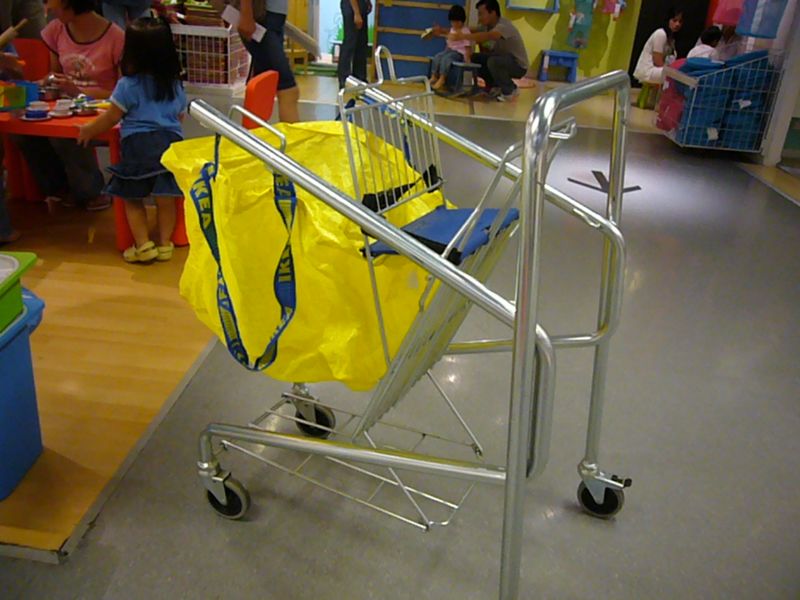
     There are a few staples of a trip to IKEA and I have to squeeze them in despite the fact that I promised this would be a very quick BLOG entry.  When I think of IKEA I think of:

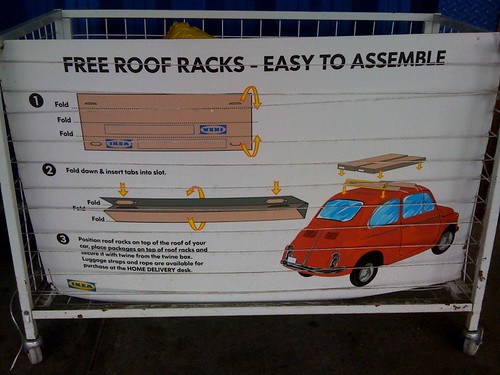
*For those of you that have not had the experience of shopping at IKEA and buying something that you need to tether to your roof, there are plenty of IKEA associates available to assist you in getting the items lifted to the top of your car, but the latest policy is that they are not allowed to help you secure anything to your car whatsoever.  They are very polite as they point you towards the direction of the twine dispenser.  That was all an “aside.”  The real point of the asterisks was to note that you should use lots of twine when secured furniture to the top of your car, van, jeep, sailboat or whatever vehicle you place to use to get your heavy and large goods home.  To me, this means a secure set of twine laterally (across), a secure set of twine lengthwise and for extra surety fancy corner pieces like wrapping a present to prevent any slippage.  The bottom line, is it takes FOREVER, it is CONFUSING, it made me SWEATY, when unsure which way to go, I got another piece of twine and went BOTH.  And on.. and on… and on…

     I finally got home, got the car unloaded (and recycled the twine) and was excited to call my daughter to tell her about the bounty of treasures for our house.  I knew the excitement was not going to be shared when she responded, “What’s IKEA Daddy?  That sounds like a weird store.”  I guess I assumed that at her age, almost hitting middle school, she would know IKEA, or been there with me or her mother at least once.  She eats on IKEA plates, drinks from IKEA cups, sleeps in an IKEA bunk bed and has an IKEA dresser.   I will take that at a complement that my home does not look like an IKEA showroom and that when she does get to discover IKEA she will enjoy shopping.  There is actually an item on the list I forgot specifically for her – a clip on light.  She sleeps on the top bunk and loves to read after her sisters are snoozing.

     Far and away the most notable portion of this post was the mystery of the missing piece when dealing with IKEA furniture.  I have yet to take the step of assembling this round of IKEA’ing but when I do, I will be sure to come back to the… MISSING PIECE.  (If any and all men have been cursed multiple times by the IKEA MISSING PIECE and blamed for it, please, PLEASE give me a quick shout out.  IT IS NOT JUST ME! I repeat, IT IS NOT JUST ME!)

     I will do whatever I can do to encourage reading over television and video games.  All three of them have handheld video game consoles.  This has not been a short post, nor has it provided anything educational or debatably useful. 

     If my next post ends up the same, then I’ll take on the topic of handheld video game consoles and where they belong (and don’t) in today’s society.  [Answer: the DUMPSTER and not in our kid’s hands].


     If you're into IKEA, checkout Rick Audet's flickr photo's of his IKEA visit - thank you for sharing Rick and great picture's!